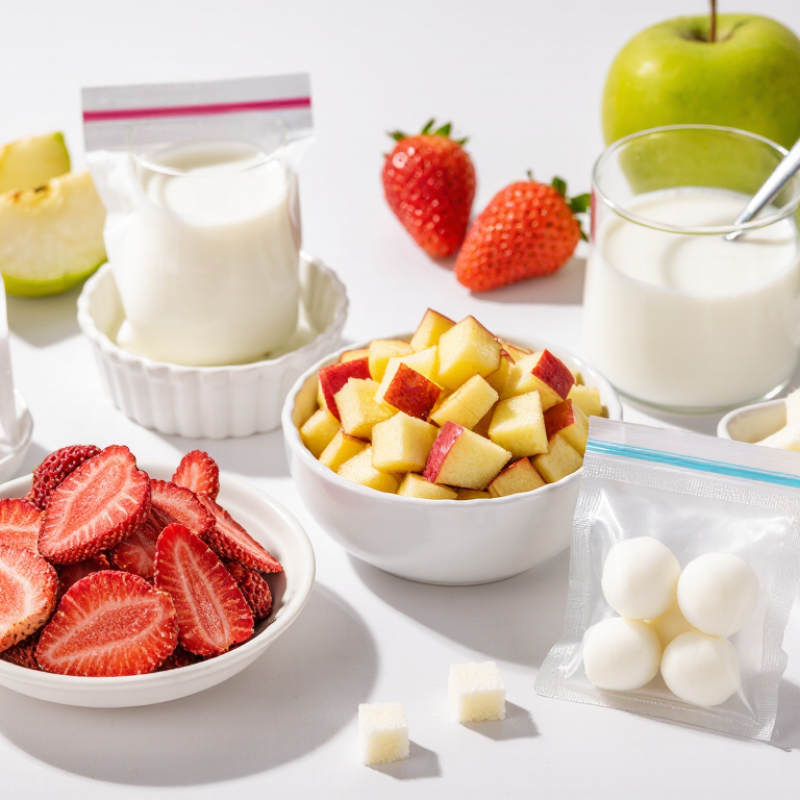
China has become an important sourcing destination for Freeze Dried Snacks, including fruit, vegetables, and ready-to-eat blends. A supplier may offer bright strawberry slices, crisp apple cubes, or lightweight yogurt bites, but appearance alone says little about consistency. Moisture control, raw-material sourcing, production capacity, and protective packaging all affect the product that reaches a buyer. Details matter.
This guide introduces Chinese suppliers and explains what buyers can examine before making a shortlist. Rather than treating any ranking as permanent, it considers practical signals: product range, documented quality systems, traceability, sample quality, communication, and export experience. Buyers can ask how batches are tested, how the product is packed against humidity, and whether specifications remain consistent across repeat orders. Taste still counts.
No single supplier suits every business. A small brand may need flexible minimum orders and custom packaging, while a large retailer may prioritize dependable volume and established quality controls. Price comparisons can help, but they may miss differences in ingredient grades, processing, or service. Some information also needs direct confirmation; online catalogs do not show everything. Use the profiles as a starting point, request current documents and samples, and compare like with like. A careful review takes time, and even then, a first order is a useful test rather than a guarantee.
Freeze-dried snacks feel light and crisp because much of their water has been removed. Yet a dry surface alone does not confirm safe storage. Water activity, written as aw, measures how available water is for microbial growth, rather than how much total moisture a snack contains. Two apple pieces can feel equally crisp and still have different aw readings.
An aw below 0.60 generally prevents bacteria, yeasts, and molds from growing. That number is useful, but not magic. It does not kill microbes already present, or replace clean handling and sound packaging. A crushed piece exposed to humid air may soften as it absorbs moisture. A sealed package with a weak closure can create the same concern during transport.
When comparing Chinese suppliers, ask how often they measure aw and whether they test representative samples from each production lot. Request calibrated-meter procedures, recorded results, and packaging checks. Not a guarantee. Ask how finished snacks are protected from humidity after testing, too. Reliable suppliers should explain their controls clearly and provide consistent records, not just quote one low reading. Product texture, package seals, and storage conditions all matter. I would still question a result without its sampling details.
Water’s triple point is about 0.01°C and 611 pascals. At this precise condition, ice, liquid water, and water vapor can coexist. Freeze-drying uses this science, but the process is not simply “drying below 0.01°C.” Frozen snacks are placed under low pressure, allowing ice to turn directly into vapor through sublimation. The exact temperature and pressure depend on the food’s structure and formulation.
Consider a strawberry slice. Its ice crystals leave tiny spaces behind, helping preserve a light, crisp texture. If heating is too aggressive, the piece may shrink, darken, or lose aroma. Small changes matter. Experienced manufacturers monitor product temperature, chamber pressure, and moisture removal throughout each batch. Still, different fruits and vegetables do not respond alike. There is no single setting that guarantees perfect results.
When comparing Chinese freeze-dried snack suppliers, ask how they control these process variables. Request product specifications, moisture data, and clear descriptions of their quality checks. Ask for samples, too: inspect the color, smell, crispness, and how quickly the snack softens after opening. A polished sample is useful, but it cannot show every production run. That uncertainty deserves honest discussion. Better suppliers explain both their controls and their limitations.
Choosing a freeze-dried snack supplier takes more than comparing prices and product photos. Check whether its food-production site follows GB 14881-2013, China’s general hygiene standard for food production. Ask for the applicable production licence and confirm that the site and product scope match your order. Request a current ISO 22000 certificate, then verify its validity, issuing body, site, and certified activities. The certificate should cover the actual factory, not just a sales office. Paperwork matters.
Look for evidence behind the documents. Ask how the supplier controls incoming fruit, vegetables, or other ingredients, and how it prevents mix-ups between production lots. During a site audit, inspect handwashing points, cleaning records, pest controls, and packaging seals. For freeze-dried products, review moisture or water-activity checks and finished-product testing relevant to the item. Request traceability records for one sample batch, from ingredient receipt to packed cartons. A tidy certificate folder is reassuring, but it cannot show every shift’s habits. I would also ask what happens when a result falls outside specification; vague answers deserve follow-up. Supplier screening is imperfect, so compare records with an audit and product samples.
China’s leading freeze-dried snack suppliers differ in range, export experience, and production scale. Some focus on single-ingredient fruit, such as crisp apple rings or strawberry pieces; others offer vegetable snacks, mixed packs, and custom cuts. Ask for current specifications, sample packaging, and allergen-handling details. A broad catalogue is useful, but consistency matters more.
Export markets can indicate experience with documentation, packaging, and shipping requirements, but they do not prove product quality. Request recent shipment references and food-safety certificates, then verify their scope and validity. Annual capacity needs the same care. A supplier may quote total line capacity, not the volume available for your order. Ask how many lines handle freeze-drying, typical lead times, and seasonal utilization. Details should match the proposed order.
A factory visit or independent audit can help confirm equipment and production controls. Check whether samples resemble bulk production in color, crunch, and piece size. Small differences happen. They still deserve an explanation. Supplier comparisons are strongest when capacity, export records, and product specifications are documented side by side—not accepted on a sales sheet alone.
This comparison uses anonymous supplier profiles rather than company names. Profiles describe common supplier types in China’s freeze-dried food sector; they are not a verified ranking of individual companies.
| Anonymous Supplier Profile | Typical Product Range | Export Markets | Annual Capacity | Useful Comparison Points |
|---|---|---|---|---|
| Fruit-focused processor | Freeze-dried strawberry, apple, banana, mango, and mixed-fruit pieces; products may be supplied as slices, cubes, or pieces. | Destination markets vary by exporter. Commonly targeted regions include North America, Europe, and East Asia. | Supplier-specific capacity is not consistently disclosed in public information; request a current production figure and the product scope it covers. | Ask about fruit origin, piece-size specifications, seasonal availability, color retention, and moisture limits. |
| Vegetable and ingredient processor | Freeze-dried corn, peas, carrot, mushroom, and other vegetables, often offered as pieces, flakes, or powders for snacks and food manufacturing. | Markets depend on the supplier’s certifications and customer requirements; overseas buyers commonly source for food-service and packaged-food applications. | Supplier-specific capacity is not consistently disclosed in public information; confirm capacity by ingredient and finished-product format. | Compare raw-material traceability, foreign-body controls, particle-size consistency, and available food-safety documentation. |
| Mixed-snack and private-label manufacturer | Fruit-and-nut mixes, coated or blended snack products, and custom retail packs using freeze-dried ingredients. | Export destinations are customer- and market-specific; confirm that packaging and labeling can meet each destination’s requirements. | Supplier-specific capacity is not consistently disclosed in public information; request separate figures for product development, packing, and routine production. | Check minimum order quantities, recipe customization, packaging options, allergen controls, and lead times. |
| Instant-food and meal-component supplier | Freeze-dried fruit, vegetables, and meal components for cereal, soups, instant meals, camping food, and other convenience-food uses. | Export suitability depends on the product category, applicable regulations, and the supplier’s documentation for the destination market. | Supplier-specific capacity is not consistently disclosed in public information; request annual output, available line capacity, and peak-season constraints. | Compare rehydration performance, ingredient specifications, shelf-life evidence, and batch-level quality records. |
Capacity figures and export coverage are not presented as verified company-level data. For a reliable supplier comparison, request recent production records, destination-market references, certifications, and product-specific technical specifications directly from each exporter.
When comparing freeze-dried snack suppliers in China, request moisture and water-activity results for the same production lot. Moisture shows total water; water activity indicates how available that water is. They are not interchangeable. ISO 18787:2017 describes methods for measuring water activity in food. The FDA’s technical guidance, “Water Activity (aw) in Foods,” uses 0.85 as an important regulatory reference point, not as a quality target for freeze-dried snacks. Ask suppliers to state their product-specific limits, test method, and meter calibration. Very crisp pieces matter.
MOQ and lead time need the same scrutiny. Ask whether the quoted minimum applies to plain product, custom seasoning, or printed packaging; each can change the production plan. Request separate timelines for samples, bulk production, and packaging, plus a recent lot’s test record. A supplier that gives a precise delivery date but cannot explain its assumptions deserves a follow-up. One detail is easy to miss: seasonal raw-material availability may affect repeat orders.
Tips: Compare sealed samples after storage, not just on arrival. Record texture, odor, and package condition, then match results against the supplier’s moisture and water-activity figures. Agree on an acceptable range before placing a larger order.
Compare moisture and water activity against illustrative buyer-set screening ceilings. These are not supplier averages or universal product standards; confirm product-specific specifications with each supplier.
MOQ and lead time: There is no single reliable benchmark across suppliers. Request written quotes for the exact product, packaging, order volume, and any customization; confirm production time separately from shipping time.
Water activity, or aw, measures how available water is for microbial growth. It differs from total moisture.
Below 0.60, bacteria, yeasts, and molds generally cannot grow. It does not destroy microbes already present. Not a guarantee.
Yes. Similar texture does not prove matching aw readings. Ask for test results from the same production lot.
Ask about sampling frequency, representative lot samples, meter calibration, recorded readings, and packaging checks. A number without details leaves me uneasy.
Moisture measures total water; aw measures how available that water is. They are not interchangeable. Request both figures for the same lot.
Humid air can soften a crushed piece. A weak seal may also let moisture in during transport.
Ask whether the minimum covers plain product, custom seasoning, or printed packaging. Request separate timelines for samples, production, and packaging.
Store sealed samples, then check texture, odor, and package condition. Compare your notes with the supplier’s test figures. Small differences can matter.
Freeze Dried Snacks are produced by removing ice from frozen food under low pressure, helping preserve shape, flavor, and many of the ingredients’ original qualities. The process relies on water’s triple point, approximately 0.01°C and 611 Pa, where ice can transition directly into vapor. For shelf stability, low moisture and water activity are important; water activity below 0.60 generally limits the growth of most microorganisms, though proper processing and packaging remain essential.
When evaluating Chinese suppliers, buyers can review food-safety systems and relevant compliance documentation, including GB 14881-2013 and ISO 22000. Compare suppliers’ product ranges, export experience, and stated annual production capacity, then request samples and specifications. Useful benchmarks include moisture content, water activity, minimum order quantity, and lead time. Clear answers and consistent quality records can help buyers identify a supplier suited to their product requirements and purchasing schedule.